
02 / Concepts · Gamma flip
Gamma flip
The price where dealer gamma turns from positive to negative, and why it matters.
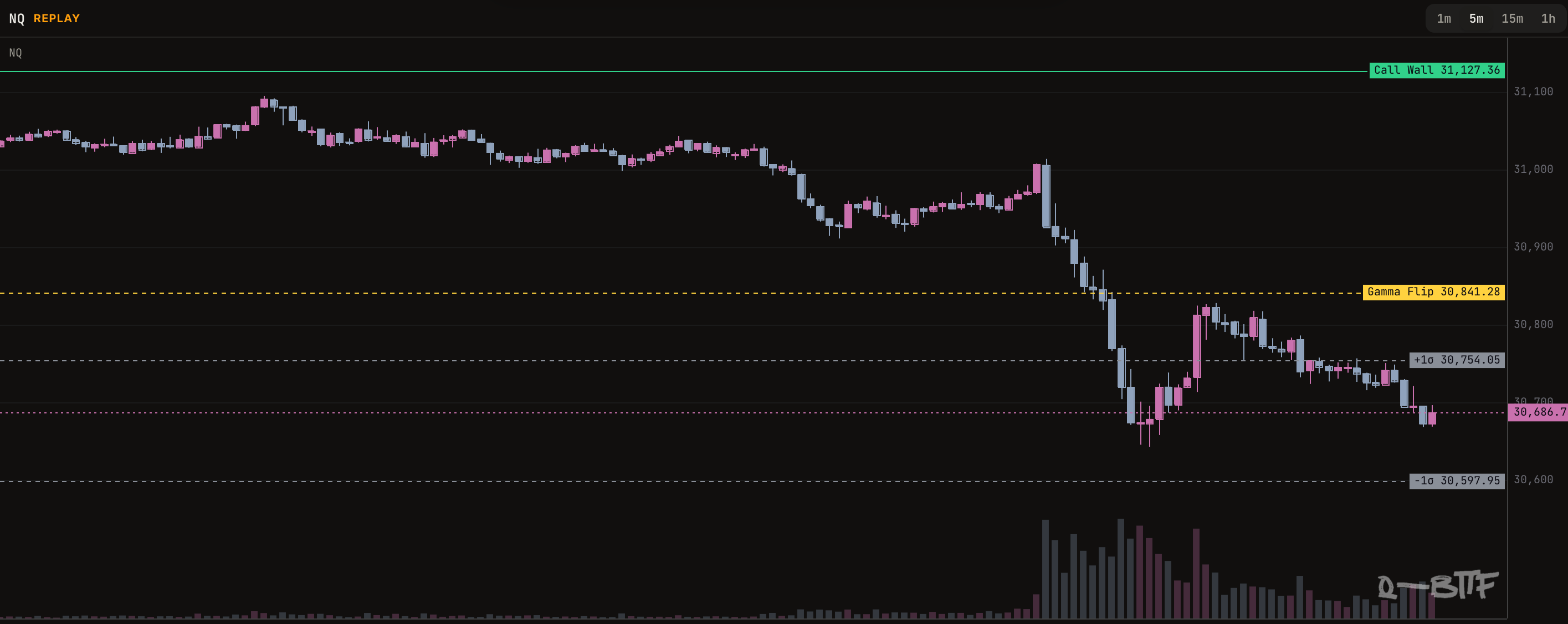
The gamma flip, also called the zero gamma level, is the price where options dealers' net gamma turns from positive to negative. Above it, dealer hedging tends to calm the market down. Below it, hedging tends to speed moves up. It is the single most watched line in gamma exposure analysis.
Above and below the flip#
| Price is | Dealers are | What tends to happen |
|---|---|---|
| Above the flip | Long gamma | Mean reversion, smaller ranges, walls hold more often |
| Below the flip | Short gamma | Trend days, wider ranges, walls break more easily |
More on this in Positive vs negative gamma.
A real example#
Gamma flip vs HVL#
q-bitf shows two versions of the turning point:
- Gamma flip follows the day-trade expiry, so it reacts to today's positioning.
- HVL, the volatility trigger, follows the whole book, so it moves slowly.
When price sits between the two, the readings disagree, and that zone tends to be choppy.
Using it#
- Mark the flip before the open alongside the call and put walls.
- A break and hold below the flip is a warning that ranges can expand.
- A reclaim of the flip often brings the market back into a range.
The flip is a zone, not an exact price. Trade it with confirmation.
Questions#
What is the gamma flip?#
The price where options dealers' net gamma changes sign. Above it their hedging damps moves; below it their hedging amplifies them.
Is the gamma flip the same as zero gamma?#
Yes. Zero gamma, the gamma flip and the flip point are names for the same level.
What is HVL?#
The volatility trigger: the same turning point measured across every expiry, so it moves more slowly than the day's gamma flip.
What positive and negative gamma mean for price, and how to read the regime badge.
What call and put walls are, why price stalls at them, and when they break.
Call and put walls, the gamma flip, HVL, the expected move and the day range.