
04 / Widgets · Order Heatmap
Order Heatmap
Today's options contracts at each strike split into call buys, call sells, put buys and put sells, to see which side is aggressive where.
Order Heatmap splits today's options trading at each strike into four columns: call buy, call sell, put buy and put sell. Brighter cells hold more contracts, the largest is lit up, and the dashed row marks spot. The header totals the contracts. Details sets the expiry scope and how many strikes to show, and lists the totals for each column.
Marked (Beta) in the widget picker: it is newer, and some of the options data behind it can lag the live market by several minutes.
Practical application#
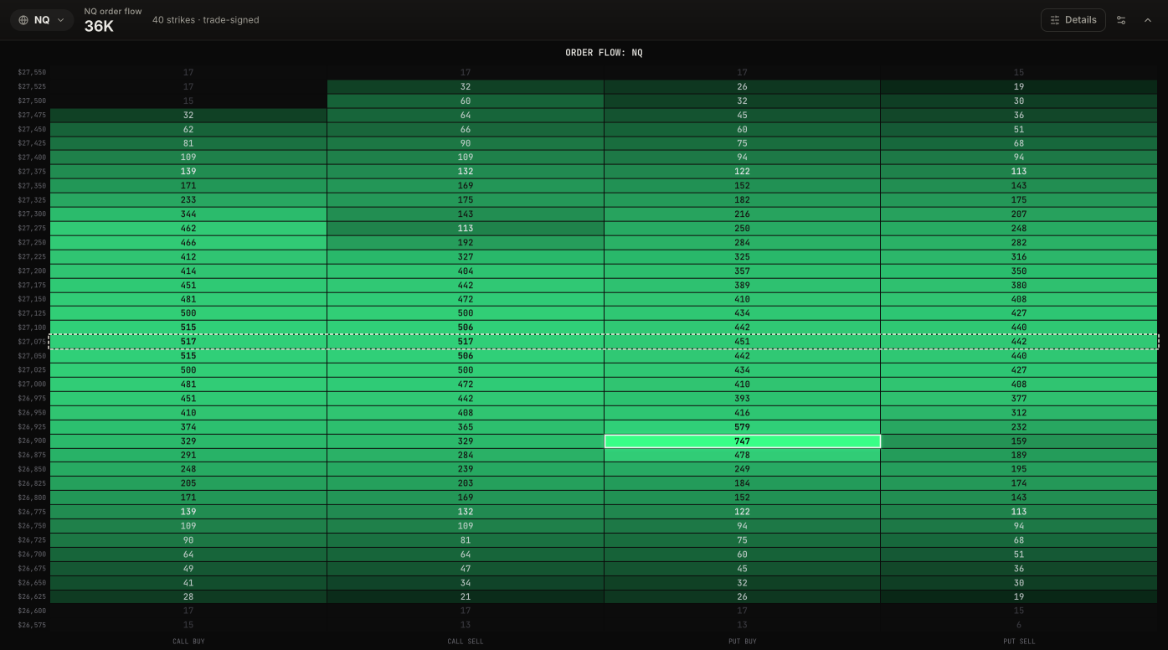
Reading it. Near spot the four columns are close to even, about 440 to 520 contracts each: ordinary two-way trading. Two places break the pattern. At 26,900, 747 puts were bought against only 159 sold, the largest cell on the map. At 27,250 to 27,275, calls were bought far more than sold: 466 and 462 bought against 192 and 113 sold. In total, buyers led on both sides: 10.0K calls bought against 9.0K sold, and 9.3K puts bought against 7.7K sold.
What it means. Traders were paying up for protection at 26,900 and for upside at the call wall at the same time: positioning for a move away from the current price in either direction.
How to use it.
- One column much brighter than its pair at a strike: someone is pressing that side there. Mark the strike.
- Put buying below price: demand for protection at that strike. In positive gamma it tends to slow a drop; below the gamma flip it can speed one up instead.
- Call selling above price: traders capping upside; rallies into that strike tend to slow.
- Switch the scope to 0DTE to see what is driving today's moves.
Where today's options trading landed, strike by strike, as gamma, delta, vanna or charm flow, or as call and put volume.
Option contracts trading far more today than their open interest, by strike, so new positioning stands out from routine trading.
One greek's dealer exposure in a grid of strikes by expiries, so you can see which expiry holds the weight.