
04 / Widgets · Chain
Chain
The day's price with dealer exposure by strike for the whole chain, and every wall, flip and vol trigger.
The Chain widget draws the session's price next to dealer exposure at every strike of the option chain, weighted by today's volume and open interest. The call walls, put walls, flip and vol trigger are labeled, with ▲ marks for the second and third walls. Switch between Chart and Table, and between a line and candles. The header shows the net exposure for the chosen expiries.
Marked (Beta) in the widget picker: it is newer, and some of the options data behind it can lag the live market by several minutes.
Practical application#
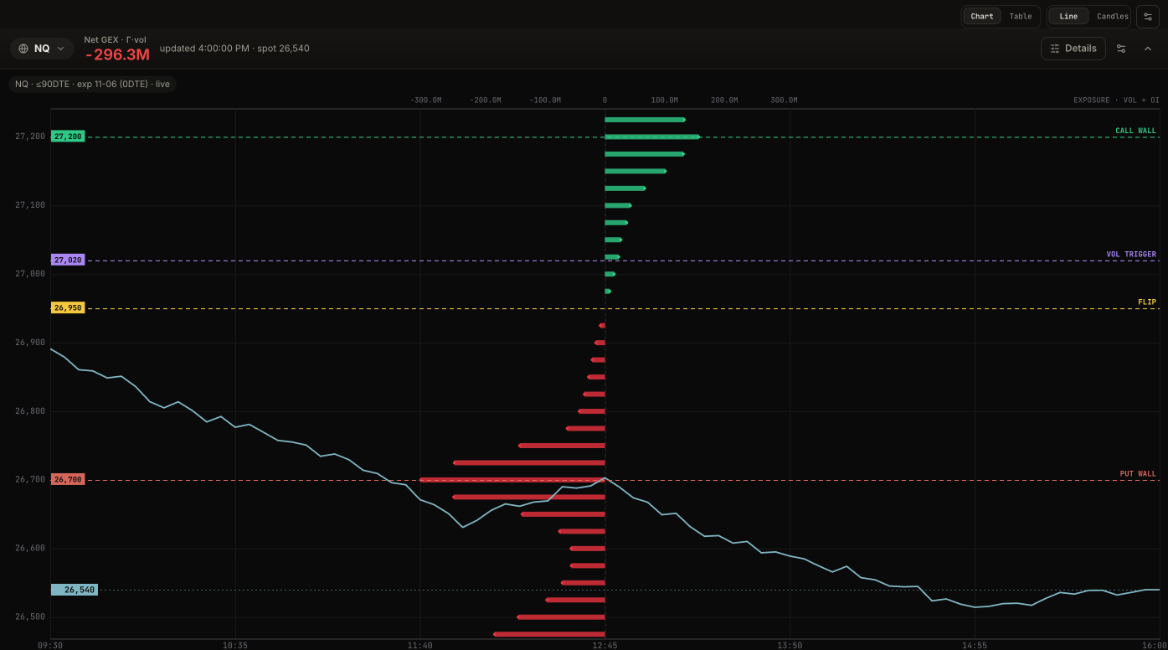
Reading it. NQ opens near 26,890, already under the flip at 26,950, and the header reads -296.3M: dealers are short gamma. Below the flip every bar is red, and the biggest ones sit around the put wall at 26,700. Price slides into the wall, breaks it around 11:40 and drops to about 26,630. The bounce that follows stalls right back at 26,700 around 12:45, and from there NQ trends lower to about 26,515 before closing at 26,540.
What it means. In short gamma, dealer hedging adds to moves instead of slowing them. A put wall can stop a fall for a while, but once it gives way the same strike tends to act as a ceiling.
How to use it.
- Price under the flip with red bars below: expect moves to run further than usual. Don't fade a break of the put wall just because it is a wall.
- A broken put wall retested from below: a lower-risk spot for shorts, with a stop back above the wall.
- Above the flip with green bars around price: the opposite: the largest green bars tend to slow price, and ranges are more likely.
- Use Table to read the exact exposure at each strike.
Net dealer gamma at every strike, with the walls, flip, vol trigger and 1D range marked, and how to read it.
Call and put open interest at every strike, the put/call ratio near spot, max pain and the key levels.
The price where dealer gamma turns from positive to negative, and why it matters.